Preserving Human Dignity. Strengthening Personal Responsibility. Ensuring Security.
“We believe that people can take responsibility when they are treated with respect. Our task is to provide the security that makes this possible.”
Our Values. For More Than 20 Years.
Supervision is necessary. But how it is carried out makes a fundamental difference.
Since RUMA was founded in 2004, we have been guided by one clear conviction: security must never come at the expense of human dignity.
With our original marker system, we began rethinking conventional testing procedures. Our aim was to replace the burden of directly observed urine collection with a secure, scientifically investigated and more dignified approach.
Over more than two decades, we have consistently developed this approach further. The original marker technology evolved into the patented RUMA Digital-System.
Our technology has changed. Our values have not.
Today, we enable people to provide the necessary evidence independently, regardless of location and without direct observation. At the same time, healthcare professionals and responsible institutions retain the assurance of verifiable results.
Because we believe that entrusting people with responsibility strengthens their self-determination. And being able to verify that responsibility reliably creates trust.
RUMA and Its History
From Protecting Privacy to a Digital Empowerment System
What began with the protection of privacy has become a system that enables personal responsibility and makes it verifiable.
A practical question arising in everyday healthcare has evolved into a patented digital verification system that allows people to provide the required evidence independently, while maintaining verifiable security for healthcare professionals and institutions.
Today, the RUMA Digital-System combines the individual, a unique single-use marker, documented marker intake, professional validation and laboratory analysis into one verified process.
What is now digital, independent of location and already in practical use began more than 20 years ago with a simple question:
How can necessary urine drug testing be carried out securely without unnecessarily compromising patients' privacy through direct observation?
A large addiction treatment centre and a major hospital in Cologne were looking for precisely such a solution. This gave rise to RUMA's founding principle:
Security should not depend on observing the individual, but on a procedure that makes the verification process independently verifiable.
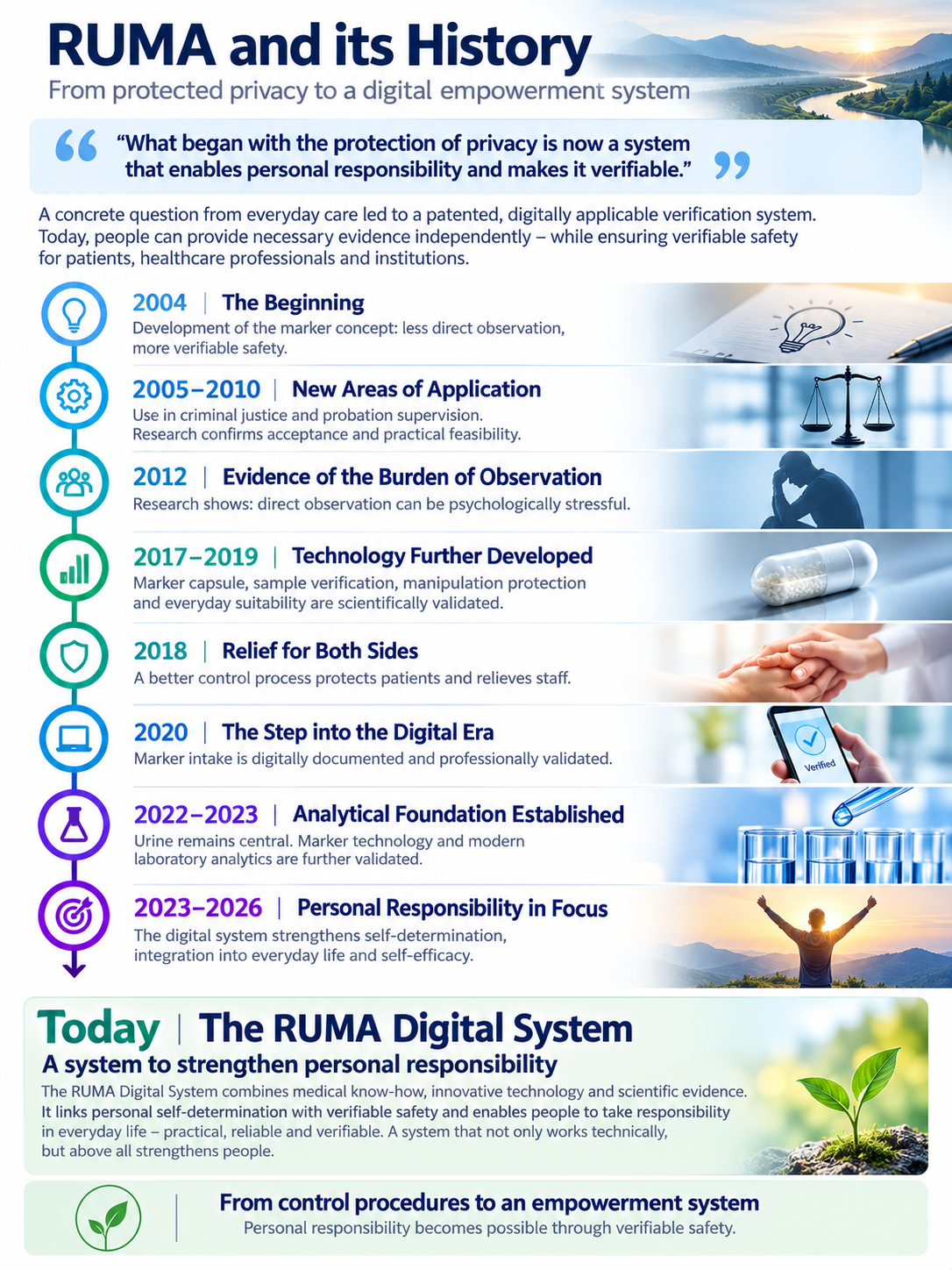
2004 | The Beginning
The founding of RUMA GmbH marked the beginning of the systematic development of the marker method. An individually assigned marker made it possible to attribute a specimen to the intended person and the specific procedure through subsequent laboratory analysis.
This established the foundation for a different approach to necessary supervision: less direct observation, greater verifiable security.
2005–2010 | From Medical Practice to Institutional Applications
It soon became clear that this principle was also relevant beyond conventional addiction treatment. The marker method was introduced in correctional facilities and probation supervision.
Scientific evaluation of the experience gained in North Rhine-Westphalia documented that the method could also be used in environments with demanding security and organisational requirements.
At the same time, RUMA became the subject of international research. Finnish research by Kaarlo Simojoki and Hannu Alho confirmed that the marker method was well accepted by patients and staff and could simplify organisational procedures.
For the first time, security and personal independence were visibly brought together.
2012 | The Burden of Direct Observation Becomes a Research Topic
Beyond addiction medicine, researchers increasingly began examining the impact of directly observed urine collection on individuals.
Research in sports science demonstrated that supervised urine collection can cause considerable psychological distress and difficulties in providing a specimen.
This provided scientific support for a concern that had shaped RUMA from the beginning:
It is not only the outcome of a test that matters – the way it is conducted matters too.
2017–2019 | Further Development of Marker Technology
With the introduction of the marker capsule, RUMA advanced the original technology.
Research examined detection windows, protection against manipulation and the effects of food and fluid intake on marker detection. These investigations further strengthened the scientific foundation for everyday practical use.
The 2019 study demonstrated that, given sufficient absorption time, reliable marker detection was possible under different dietary and fluid intake conditions.
2018 | Patients and Staff Come into Focus Together
Research in forensic psychiatry made it particularly clear that direct observation can be burdensome not only for patients.
Staff also experience the testing process as psychologically and organisationally demanding.
This broadened RUMA's original approach: a better procedure should protect privacy, provide security and also reduce the burden on those responsible for carrying out testing.
2020 | The Transition to Digital Technology
The decisive development came with the digital documentation of marker intake.
What previously had to be supervised on site could now be documented digitally and subsequently validated by a qualified professional.
The marker method thus became a location-independent verification process. Patients could carry out essential steps independently without compromising the verifiability of the procedure.
2022–2023 | Further Strengthening the Analytical Foundation
A direct comparison of urine, oral fluid and capillary blood confirmed that the appropriate specimen always depends on the specific analytical question – and that urine continues to play a central role because of its established analytical methods and often extended detection windows.
Further research examined the compatibility of marker technology with modern LC-MS/MS laboratory analysis. This also provided analytical support for the transition from the original liquid marker to the lower-dose marker capsule.
RUMA does not replace established laboratory analysis. It adds a verifiable link between the individual, the procedure and the specimen.
2023–2026 | From Digital Supervision to Personal Responsibility
Scientific research into the Digital-System also changed the central question.
It was no longer solely about whether a specimen could be collected and verified securely.
Increasingly, the question became how people could take responsibility for the verification process themselves.
Longer-term use demonstrated a shift towards greater independence, reduced burden, better integration into everyday life and increased self-efficacy.
Step by step, the original supervision procedure developed into an approach centred on empowerment.
Today | The RUMA Digital-System
Today, the patented RUMA Digital-System, already established in practical use, connects:
Individual → Unique Single-Use Marker → Documented Intake → Professional Validation → Laboratory Analysis → Verified Result
This creates a continuous, traceable connection between the individual, their actions, the specimen and the laboratory findings.
Yet the most important development is not digitalisation alone.
From a Supervision Procedure to an Empowerment Tool
RUMA changes the individual's role in the testing process.
Instead of having to carry out a necessary procedure exclusively under direct external supervision, the individual takes responsibility for performing it independently.
Within a clearly defined framework, people act on their own responsibility – while the system provides the safeguards needed to verify their actions objectively afterwards.
Personal responsibility does not replace security. Security is what makes personal responsibility possible.
What began with protecting privacy has become a patented digital system that gives people greater independence and makes that independence verifiable.
This is RUMA's journey: from an alternative to directly observed urine collection to a digital verification infrastructure that combines security and empowerment.
Team & Expertise Network
Clear Responsibility. An Established Network of Expertise.
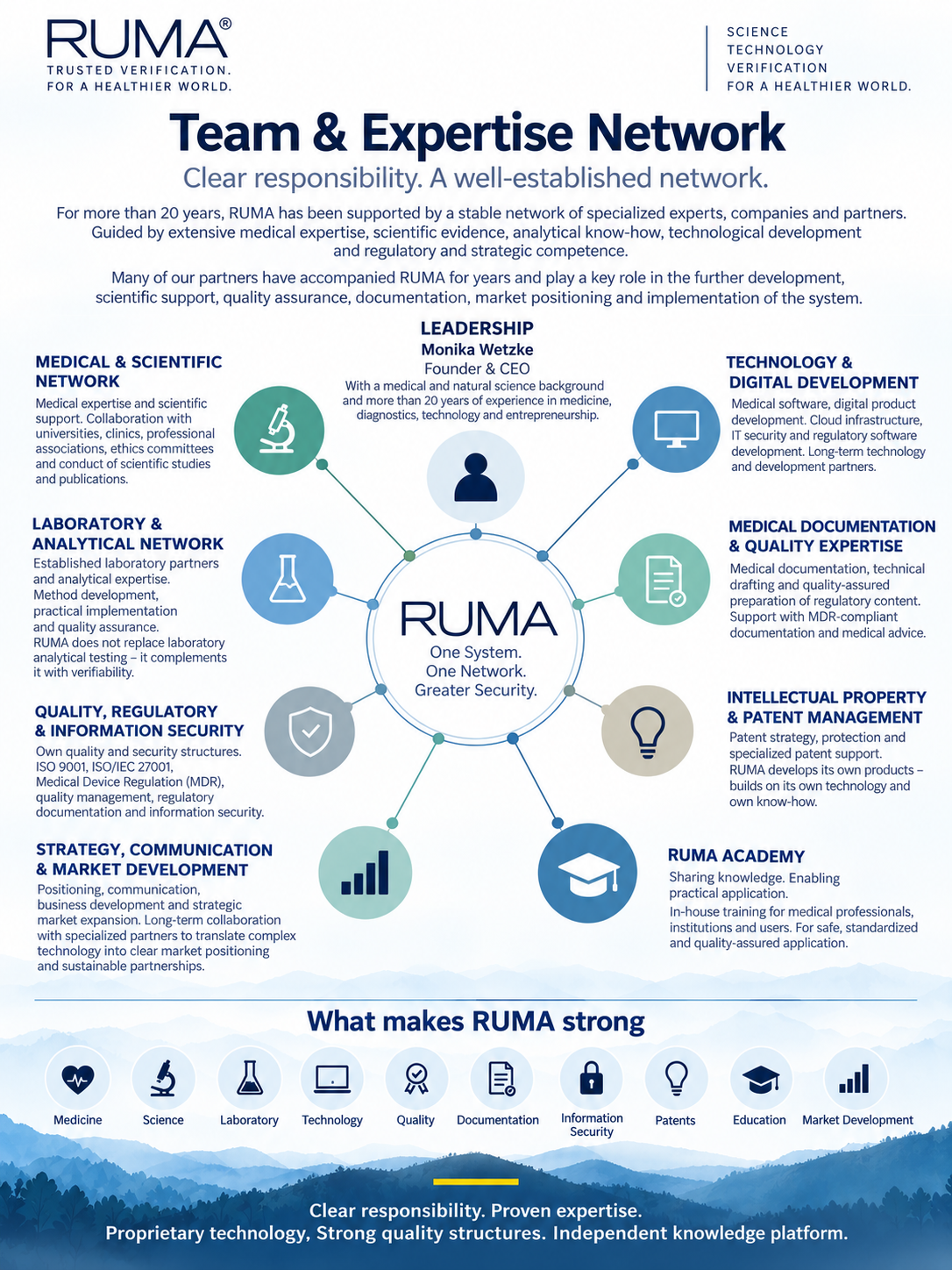
For more than 20 years, RUMA has been supported by a stable network of specialist professionals, companies and partners.
Led by Monika Wetzke, this network brings together medical, scientific, analytical, technological, regulatory and strategic expertise.
Many of these partners have worked with RUMA for years and are integral to the system's development, scientific evaluation, quality assurance, documentation, positioning and implementation.
Leadership
Monika Wetzke | Founder & CEO
With a background in medicine and the natural sciences, Monika Wetzke has been bringing together medicine, diagnostics, technology and entrepreneurship for more than 20 years.
As the founder and CEO of RUMA, she established the company, developed the brand and continuously advanced its patented marker technology into today's RUMA Digital-System.
She is the inventor of the digital verification principle and is now responsible for RUMA's strategic development, international partnerships and positioning as a verification infrastructure for healthcare and regulated processes.
Her earlier work on international corporate, branding and media projects also contributed to her extensive experience in strategic development, positioning, partnerships and market expansion.
Medical & Scientific Network
Medical expertise and scientific research form a central pillar of RUMA.
RUMA works with independent scientific advisers and research partners who support scientific projects from the initial research question through to publication.
Their work includes study design, involvement of ethics committees, practical implementation of scientific investigations, data evaluation and publication of results.
This ensures that new developments are assessed not only technically and practically, but also investigated and documented through structured scientific research.
From the initial research question and study design to publication, scientific expertise supports the entire process.
Technology & Digital Development
RUMA works with specialist partners in medical software, digital product development, cloud infrastructure, IT security and regulatory software development.
Long-standing technology and development partners support the technical implementation and continuous advancement of the Digital-System.
Laboratory & Analytical Network
Laboratory analysis is an essential component of verification.
RUMA works with established laboratory partners and analytical specialists who support practical implementation, method development and quality assurance.
RUMA does not replace laboratory analysis – it adds verifiability.
Medical Documentation & Quality Expertise
Another important component is medical documentation, specialist advice and the quality-assured preparation of regulatory information.
This includes TÜV-certified expertise in documentation and medical advice.
Such expertise is particularly important for a medical device: development must not only produce a functioning product, but also be documented in a traceable, structured and regulatory-compliant manner.
Quality, Regulatory & Information Security
Over many years, RUMA has established its own quality and security structures.
These include ISO 9001, ISO/IEC 27001, medical device quality management, regulatory documentation and information security.
Quality and security are therefore not external additions but integral parts of the company's structure.
Intellectual Property & Patent Management
From the original marker technology to today's digital verification principle, technological development has been continuously supported by patent strategy, intellectual property rights and specialist patent management.
RUMA does not simply develop products – it builds its own technological expertise and intellectual property portfolio.
Strategy, Communication & Market Development
Technology alone does not create a market.
RUMA therefore works with long-standing specialists and partner companies in strategic positioning, communication, business development and market expansion.
This helps translate complex technology into clear market positioning, accessible communication and sustainable partnerships.
RUMA Academy
Sharing Knowledge. Enabling Secure Application.
By establishing its own training academy, RUMA is adding another important dimension to its network of expertise.
The aim is not merely to provide healthcare professionals, institutions and users with technology, but also to equip them with the knowledge required for secure, standardised and quality-assured use.
What Makes RUMA Strong
Medicine · Science · Laboratory Analysis · Technology · Quality · Documentation · Information Security · Patents · Professional Training · Market Development
Clear Responsibility. Established Expertise. Proprietary Technology. In-House Quality Structures. Our Own Knowledge Platform.
Press & Media
RUMA in Public and Professional Discourse
RUMA's development has attracted coverage from German and international media over many years – from the first reports on the marker system to today's digital verification solution.
The coverage has repeatedly addressed the issues that continue to shape RUMA: protection against manipulation, unique specimen attribution, privacy and the question of how necessary supervision can be made more secure and more respectful of human dignity.
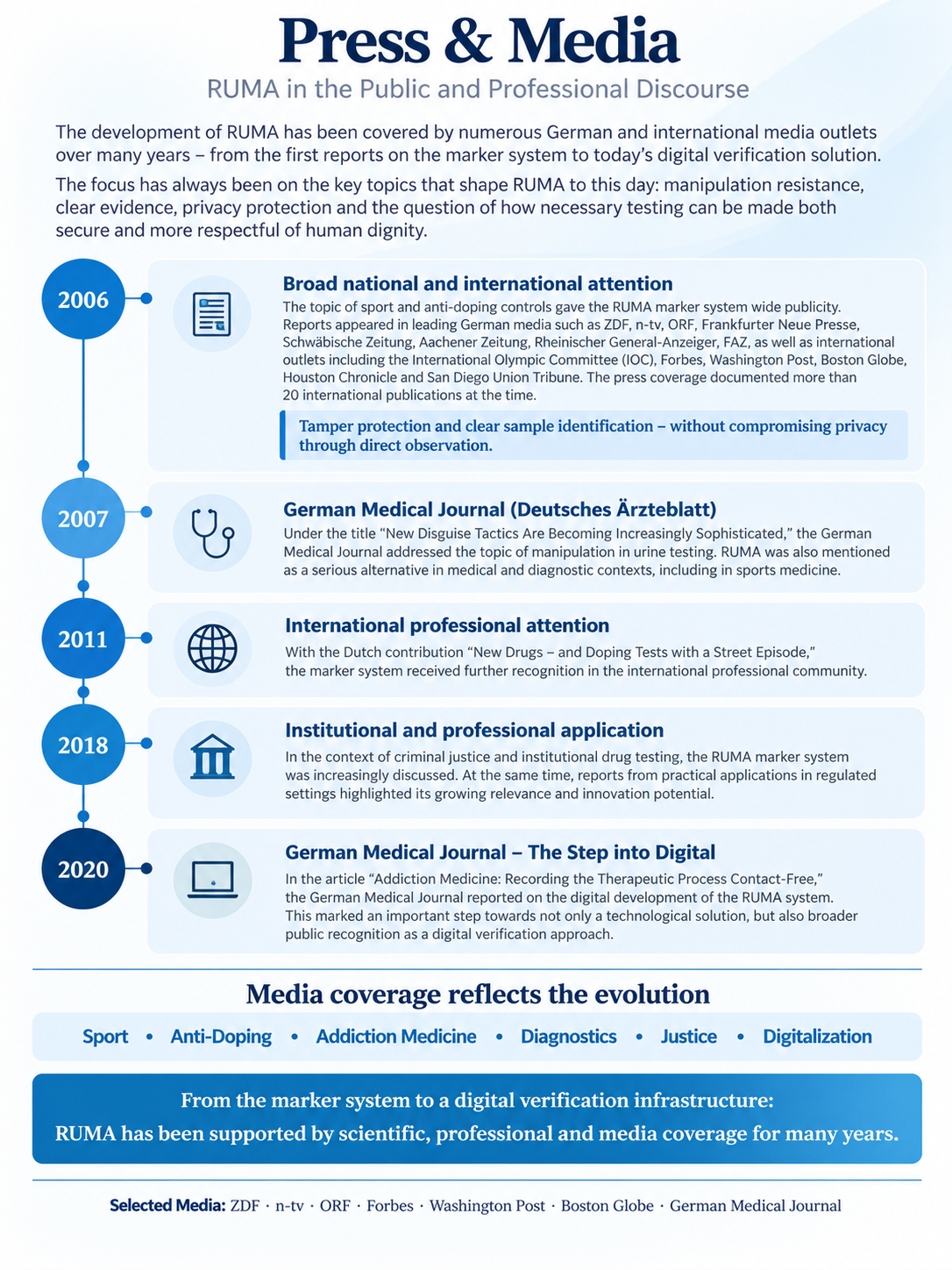
2006 | Widespread National and International Attention
The RUMA Marker System attracted widespread public attention in connection with sport and doping controls.
In Germany, coverage appeared in ZDF, n-tv, Frankfurter Neue Presse, Schwäbische Zeitung, Aachener Zeitung, Remscheider General-Anzeiger, Analytik.de and Krankenkassen.de, among others.
Internationally, reports appeared in ORF Science, Forbes, The Washington Post, The Boston Globe, Houston Chronicle and The San Diego Union-Tribune.
The press portfolio from that period documents 15 German and more than 20 international publications.
Even then, the central principle behind RUMA was clear:
Protection against manipulation and unique specimen attribution – without unnecessarily compromising privacy through direct observation.
2007 | Deutsches Ärzteblatt
Under the headline “Die Verschleierungstaktiken werden immer raffinierter” (“Concealment Tactics Are Becoming Increasingly Sophisticated”), Deutsches Ärzteblatt addressed manipulation in urine drug testing.
This brought RUMA to the attention of medical and diagnostic professionals beyond the context of sports reporting.
2011 | International Professional Recognition
The Dutch article “Nieuwe drugs- en dopingtest met ‘streepjescode’” (“New Drug and Doping Test Using a Barcode”) brought further international professional attention to the marker system.
2018 | Institutional and Professional Applications
The RUMA Marker System also received attention in the context of correctional facilities and institutional drug screening.
Public perception increasingly shifted from reporting on an innovative concept towards its practical use in regulated environments.
2020 | Deutsches Ärzteblatt – The Transition to Digital Technology
In the article “Suchtmedizin: Kontaktlos die Therapietreue erfassen” (“Addiction Medicine: Monitoring Treatment Adherence Without Direct Contact”), Deutsches Ärzteblatt reported on the digital development of the RUMA system.
This highlighted how both the technology and public perception had evolved:
From the Marker System to Digital Verification.
Media Coverage Reflects RUMA's Development
Over the years, media reporting has accompanied RUMA across a wide range of applications:
Sport · Doping Control · Addiction Medicine · Diagnostics · Justice · Digitalisation
From the marker system to a digital verification infrastructure, RUMA has attracted scientific, professional and media attention for many years.
Selected Media
ZDF · n-tv · ORF · Forbes · The Washington Post · The Boston Globe · Deutsches Ärzteblatt